
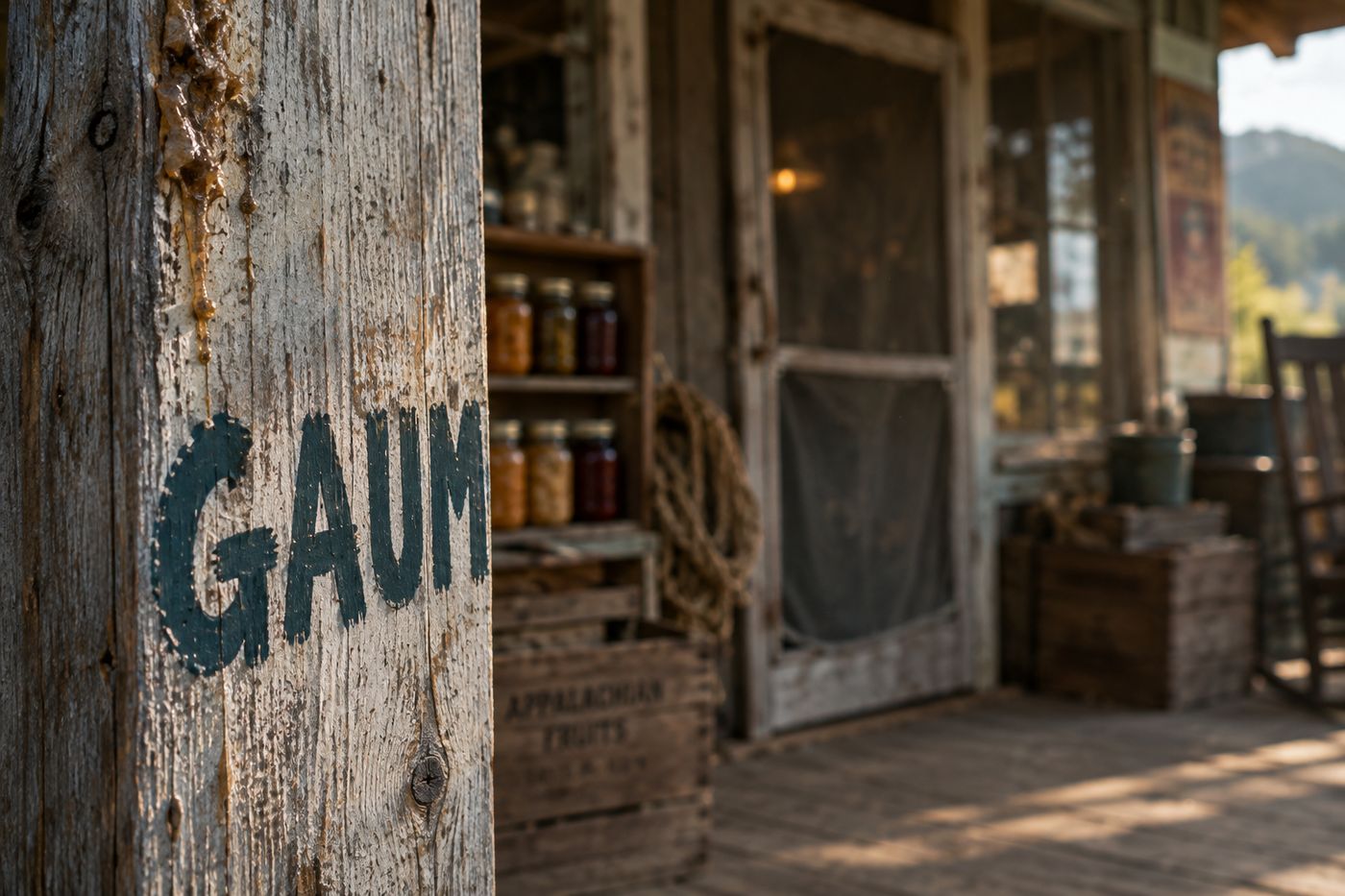
1 What It Means
To smear, daub, or dirty something with a sticky or greasy substance, or to botch a task so thoroughly it becomes a mess.
2 Caught in the Wild
"Don't gaum up that clean shirt with axle grease before we even get to town."
Illustrative usage · Undated
3 Where It Comes From
Gaum traces back to Old Norse gaumr, meaning attention or heed, which entered northern English dialects as a verb for handling something carelessly. Over centuries the sense drifted from inattention to the physical mess that carelessness leaves behind, smeared grease, spilled food, a job fouled up. English settlers carried the word into the Appalachian backcountry, where it stuck fast in isolated hollows even as standard English moved on without it. It never had a reason to travel further. Cities did not need a word for grease on a churn dasher or mud on a porch rail. The mountains kept using it because the mess kept happening, and nobody ever proposed a better word for it.
4 The World Behind the Word
Appalachian English is not broken standard English, it is its own long-running dialect, shaped by Scots-Irish, English, and German settlers who arrived in the 1700s and then stayed largely cut off from the coastal cities for two centuries. Steep terrain and few roads meant communities held onto older pronunciations, grammar, and vocabulary long after they faded elsewhere in the English-speaking world. Gaum belongs to a whole family of these survivals, words for physical, everyday states, a messy porch, a crooked fence post, a chilly morning, that mainstream English eventually replaced with vaguer terms. Linguists like Michael Montgomery have spent careers cataloging this vocabulary precisely because it is disappearing as younger generations leave for cities and pick up broadcast English instead. Every word like gaum that survives is evidence of how long a dialect can hold a line against flattening.
5 Use It Yourself
Reach for it when a toddler finger-paints the dog, when someone leaves a greasy handprint on a white wall, or when a coworker gaums up a shared spreadsheet past all recognition. It carries no formal register at all, so save it for family texts and casual conversation rather than a work email, unless you want to sound like you grew up somewhere with a good porch.
Try it out loud
He gaumed up the whole recipe by dumping in the wrong flour and calling it a shortcut.
🗝️The Deep Cut File
The same Old Norse root, gaumr, meaning heed or attention, also gave English the now-rare adjective gaumless, meaning inattentive or careless, once common enough in northern England to appear in glossaries alongside words like feckless. Gaumless faded from wider use while gaum survived in Appalachia through sheer isolation, a strange split fate for two words born from the same root. Some Appalachian speakers still use both forms today, gaum for the mess and gaumless for the person careless enough to have made it, a pairing that essentially diagnoses cause and effect in two words nobody else kept around.