
1 What It Means
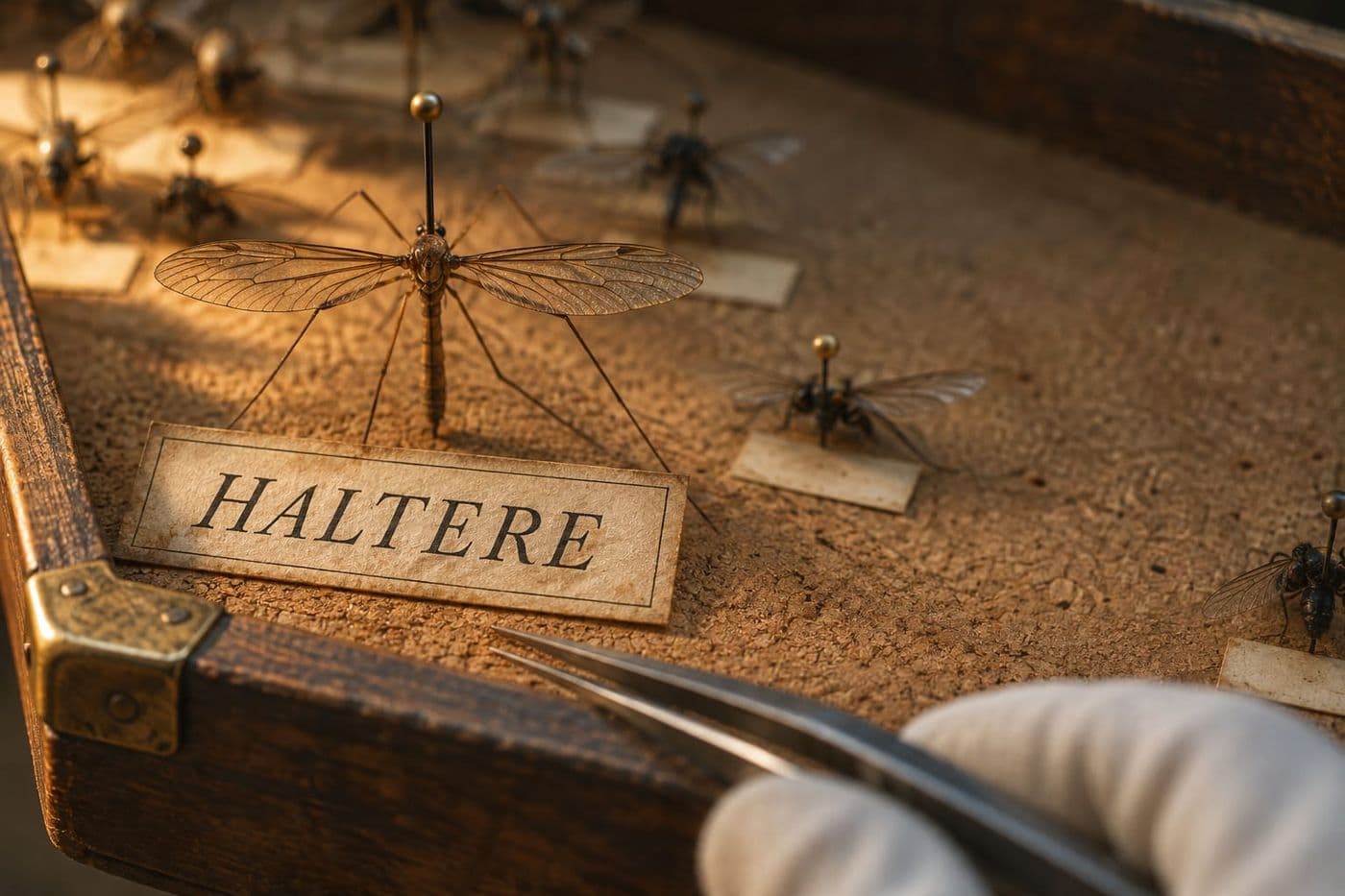
The tiny club-shaped organs behind a fly's wings that vibrate like gyroscopes and tell the insect how its body is turning in flight.
2 Caught in the Wild
Under the microscope, the haltere is easy to spot: a thin stalk ending in a small knob, tucked just behind each wing.
Illustrative usage. · Undated
3 Where It Comes From
The word is Greek. Haltēres is the plural of haltēr, a weight, from hallesthai, to leap. Ancient Greek long jumpers swung stone or metal weights forward in their hands to carry themselves farther. Early anatomists looking at a fly saw two small knobbed stalks and borrowed the name for the resemblance. That was naming by sight, not by function, and the job these organs did stayed a puzzle for a long time. The word never escaped because the thing hides. A haltere is a speck tucked behind the wing, and anyone who glances at a fly sees the wings. Entomologists, the scientists who study insects, kept the word. Everyone else kept saying wings.
4 The World Behind the Word
Flies belong to the order Diptera, which means two wings. They fly with the front pair. The back pair shrank over evolutionary time into halteres. Here is the trick. In flight, each haltere beats up and down in step with its wing, but in the opposite direction, like a tiny flail. When the fly's body starts to rotate, a physical effect called the Coriolis force pushes the swinging knob sideways. At the base of the stalk sit small dome-shaped strain sensors, which feel that push and fire signals straight to the wing muscles. The fly corrects its course within a wingbeat or so. It needs that speed because a fly can change direction in a blink, faster than its eyes can reliably report. Remove the halteres and the insect cannot hold a steady flight. It tumbles. Mosquitoes and crane flies carry the same equipment.
5 Use It Yourself
Haltere earns its keep the next time a fly dodges your hand with irritating ease. You can announce, with total accuracy, that it is not luck, it is gyroscopes. It also works for the pub quiz that asks how a fly stays level. The register trap is simple: it is a technical term, so drop it among people who know insects and expect a nod. Drop it at a dinner table and expect a pause, then a question. Be ready with the Greek jumpers.
Try it out loud
That fly keeps escaping my newspaper because its halteres detect my swing before I've even finished it.
🗝️The Deep Cut File
Flies are not the only insects that traded a wing pair for a balance organ. Males of the Strepsiptera, an order of small parasitic insects sometimes called twisted-wing parasites, do it the opposite way around. Their halteres sit on the middle segment of the body, where a fly's working wings attach, while their hind wings stay large and do the flying. Nature built the same gyroscope twice, on different segments, in unrelated lineages. It is a tidy example of convergent solutions to one problem: staying upright in the air. Biologists still study haltere circuits as a model of fast sensory feedback, and engineers have eyed them as inspiration for tiny flying robots.