1 What It Means
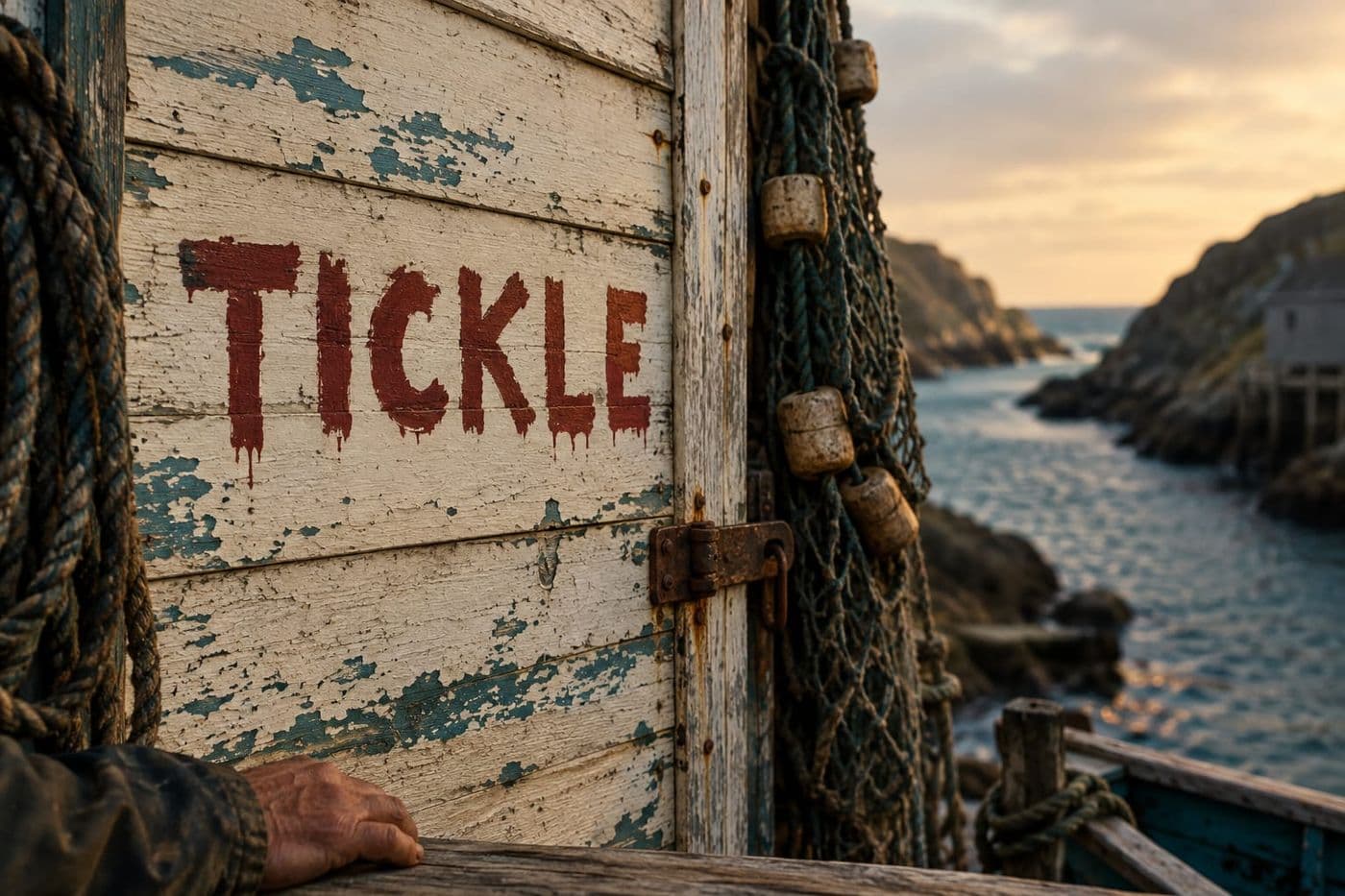
A narrow stretch of sea between an island and the mainland or between two islands, tight enough that boats must pick their way through it.
2 Caught in the Wild
We took the boat through the tickle at slack tide and had the cove to ourselves by supper.
Illustrative usage. · Undated.
3 Where It Comes From
Nobody can prove the path. The likeliest story is that this is the ordinary verb tickle, borrowed by fishermen for water that is tricky, touchy, and easy to get wrong. Dictionaries of Newfoundland English treat it as a local sense of a familiar word, not a foreign import. That's why it stayed home. Elsewhere a strait was already called a strait, a sound, or a channel, and those words had charts and textbooks behind them. Inside Newfoundland, the places themselves wore the word on their names, so there was no reason to swap it out. Settlement hugged the coast, the vocabulary stayed with the boats, and the wider English-speaking world never needed a second word for the same thing.
4 The World Behind the Word
Newfoundland's outports are small fishing settlements, many once reachable only by water. The coastline is a ragged edge of islands, bays, and headlands, and for a long time the sea was the road. A tickle is a piece of that road. Because it's narrow, the water in it behaves differently from open sea. Tides and currents squeeze through, and a skipper has to know where the rocks sit and when conditions let a boat pass safely. Local knowledge mattered more than any chart. A tickle could also work the other way, offering a short route between settlements or a calm spot out of the wind. The word carries all of that at once: shortcut, shelter, and hazard. Several places in the province carry it in their names, so a map of Newfoundland reads like a record of what people needed to remember about their water.
5 Use It Yourself
Use it on any coastal trip where two bits of land nearly touch. Kayaking past a gap between an island and the shore, you can announce that you're heading for the tickle, and anyone from Newfoundland will nod. Everyone else will assume you're being strange. The register trap is simple: it sounds playful, but it's a plain geographic term there, with no joke attached. Don't use it for a river, a creek, or a hallway. It means salt water.
Try it out loud
We paddled out of the harbour and squeezed through the tickle just before the tide started to run.
🗝️The Deep Cut File
English has an old relative of this word hiding in plain sight. Ticklish has long meant more than easily laughed at. It can describe a situation that's delicate, unstable, or risky, the kind of problem where one wrong move tips everything over. That sense is a few centuries old in standard English. It's the same instinct a Newfoundland skipper had when naming a gap of water that needed care and respect. The ordinary adjective went indoors and got applied to diplomacy and awkward conversations. The noun stayed on the water and went on naming real rock, real current, and real passages that boats still thread today.