1 What It Means
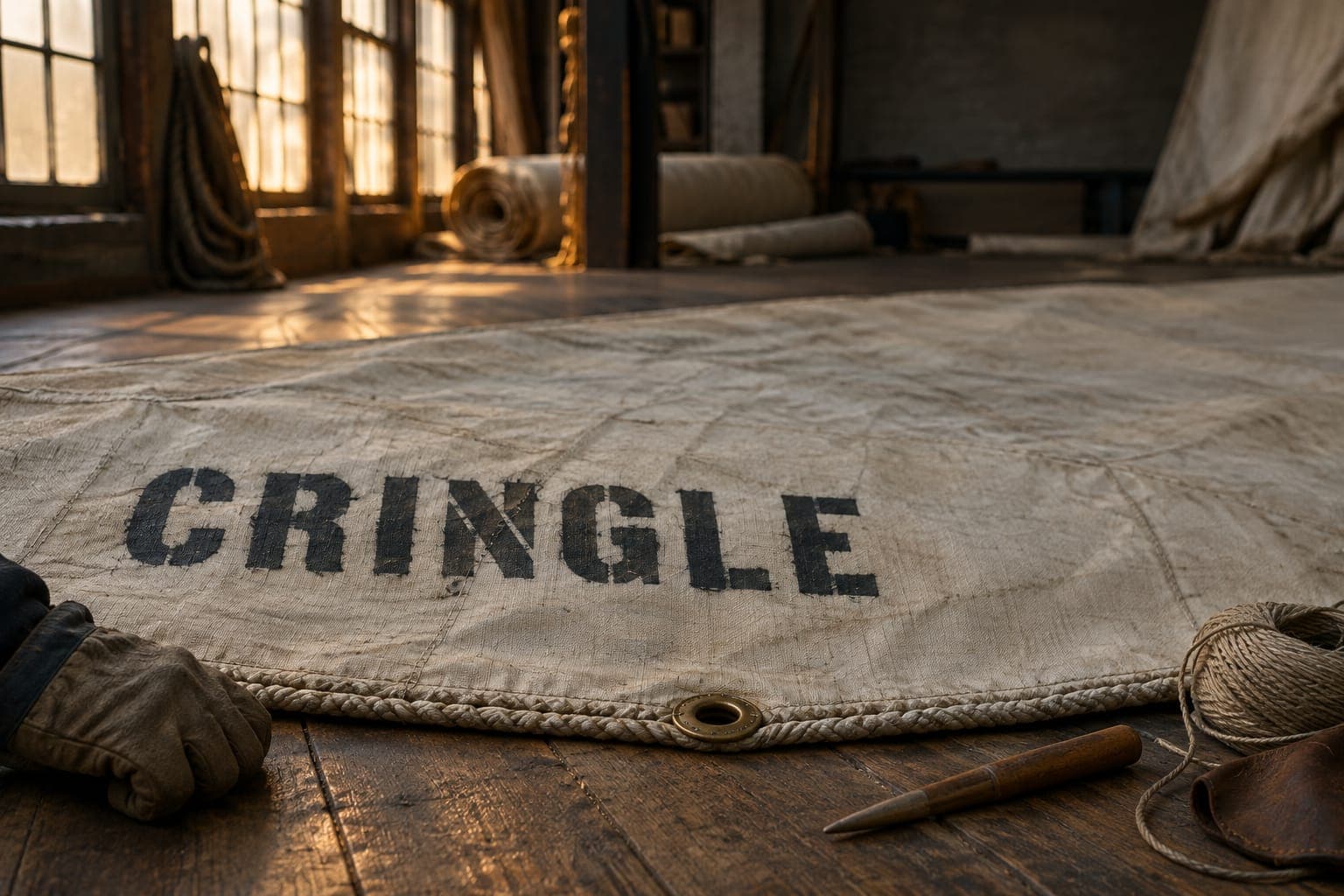
A small ring of rope or metal sewn into the edge of a sail, used to attach lines or fasten the sail to its spar.
2 Caught in the Wild
The sailor threaded the reef line through the cringle at the leech and hauled until the canvas lay flat and small against the boom.
Illustrative usage. · Undated.
3 Where It Comes From
The trail leads to Low German, where kringel meant a little ring, a diminutive of kring, circle. Sailors on the North Sea coasts borrowed it, and English picked it up by the early 1600s. It never went mainstream because the thing it names lives in one place: the edge of a sail. A sail is not an object most people handle, and the ring itself is easy to overlook. Landlubbers say hole or loop, and that is close enough for any conversation held on land. Meanwhile the trade kept its vocabulary the way crews always do, by saying it aloud on deck every day. The word survives because the job survives, and no general term ever matched its precision.
4 The World Behind the Word
A sail is a big sheet of fabric that must take enormous force and pass it somewhere useful. Fabric alone would tear at any point where a line pulled on it. So the edges are reinforced, and the corners most of all. Sailmakers sew a rope into the edge, called a boltrope, and at points of heavy strain they work in a ring. That ring is the cringle. Traditionally it was made from rope, often wrapped around a metal liner called a thimble so the line running through would not chafe. Modern sails often use stamped metal rings pressed into reinforced patches. The corners of a sail each have one, and rows of them sit along the edge so a sail can be shortened. That shortening is called reefing, and the reef lines run through those cringles. The ring spreads the load into the cloth and the rope. Without it, the pull would find one weak stitch and tear it.
5 Use It Yourself
The word earns its keep if you ever sail, rig a tarp, or hang a canvas awning. When a camping tarp has a grommeted corner and a friend asks where to tie the line, you can point at the cringle and sound like you know things. Register trap: it sounds like a cute made-up word, so people may suspect you of inventing it. Use it only among people who sail or tolerate you. Everyone else will hear a sneeze.
Try it out loud
Tie the line through the cringle at the corner, not the flapping edge, or the whole tarp will tear loose.
🗝️The Deep Cut File
The same Low German root that gave sailors the cringle also gave German bakers the Kringel, a ring-shaped pastry or pretzel. English borrowed that too, and it became the kringle, a flat, ring-shaped pastry. It is now a regional specialty in places with Scandinavian heritage, including Racine, Wisconsin. So the loop on the corner of a sail and a breakfast pastry are cousins. Both words began as a plain term for a little circle, and each carried it into a different world. One went to sea, to be hauled on in a gale. The other went to the oven, to be eaten with coffee.