1 What It Means
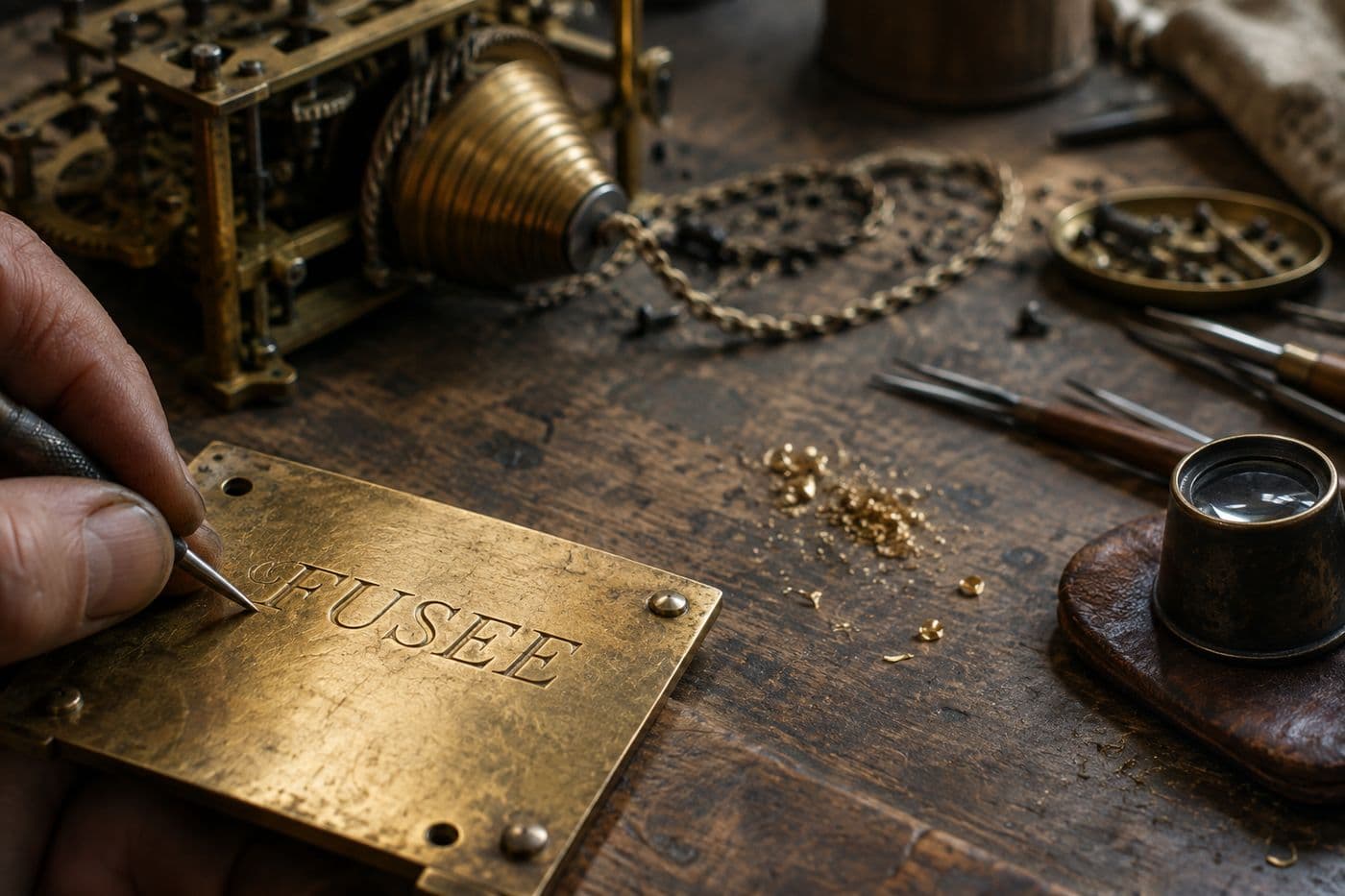
A cone-shaped, spirally grooved pulley in old clocks and watches that evens out the mainspring's pull as it winds down.
2 Caught in the Wild
The fusee chain runs from the barrel to the fusee cone, compensating for the mainspring's diminishing force as it unwinds.
Illustrative usage · Undated
3 Where It Comes From
The word comes from French fusée, a spindle-shaped thing, itself from Latin fusus, a spindle. Clockmakers borrowed the shape-word for the cone-shaped part that solved a real mechanical headache: mainsprings pull hardest when fully wound and weaken as they run down, which used to make clocks run fast then slow. The fusee's tapering cone changed leverage as the chain wound off it, correcting for that. The word never crossed into general English because the object it named was surgically specific to spring-driven timekeeping, and once cheaper, more accurate solutions like the going barrel and later quartz movements took over, the whole mechanism, and its name, retreated into restoration workshops and horology textbooks.
4 The World Behind the Word
Before quartz, before even reliable pendulum regulation, portable timekeeping ran on a coiled mainspring, and mainsprings have an inconvenient habit: they exert more torque when fully wound than when nearly spent. Left uncorrected, an early watch would run fast for the first hours after winding and drag by the end. The fusee fixed this with pure geometry. A chain or gut line wound around a barrel connected to the tapering fusee cone, so that as the spring's pull weakened, the chain rode onto a wider part of the cone, restoring the leverage lost. Watchmakers who could cut and fit a fusee correctly were valued specialists, since a badly matched cone made a watch worse, not better. English clockmakers used the mechanism for roughly 250 years, right up until improved mainspring alloys and going-barrel designs made the extra parts unnecessary.
5 Use It Yourself
This one rarely fits casual conversation, but it is a good word to drop at an estate sale or antique fair when someone opens the back of an old pocket watch and asks what that little chain and cone are doing in there. It also works as a shorthand for any fix that compensates for something weakening over time, though you will need to explain the reference.
Try it out loud
The watchmaker pointed out the tiny fusee chain and explained why nobody bothers making them anymore.
🗝️The Deep Cut File
The same French root that gave clockmakers 'fusee' also gave English the word 'fuse,' both tracing back to the idea of a spindle-shaped cord or cone. It also survives in an unrelated-sounding cousin: the roadside emergency flare that railroad crews and stranded drivers once called a fusee, named for its own spindle-like shape and the way its wick burned down like a slow spring releasing tension. So a Victorian watch part and a highway warning flare share a great-grandparent word, even though nobody setting one off on the shoulder of I-80 has ever thought about clockwork.