
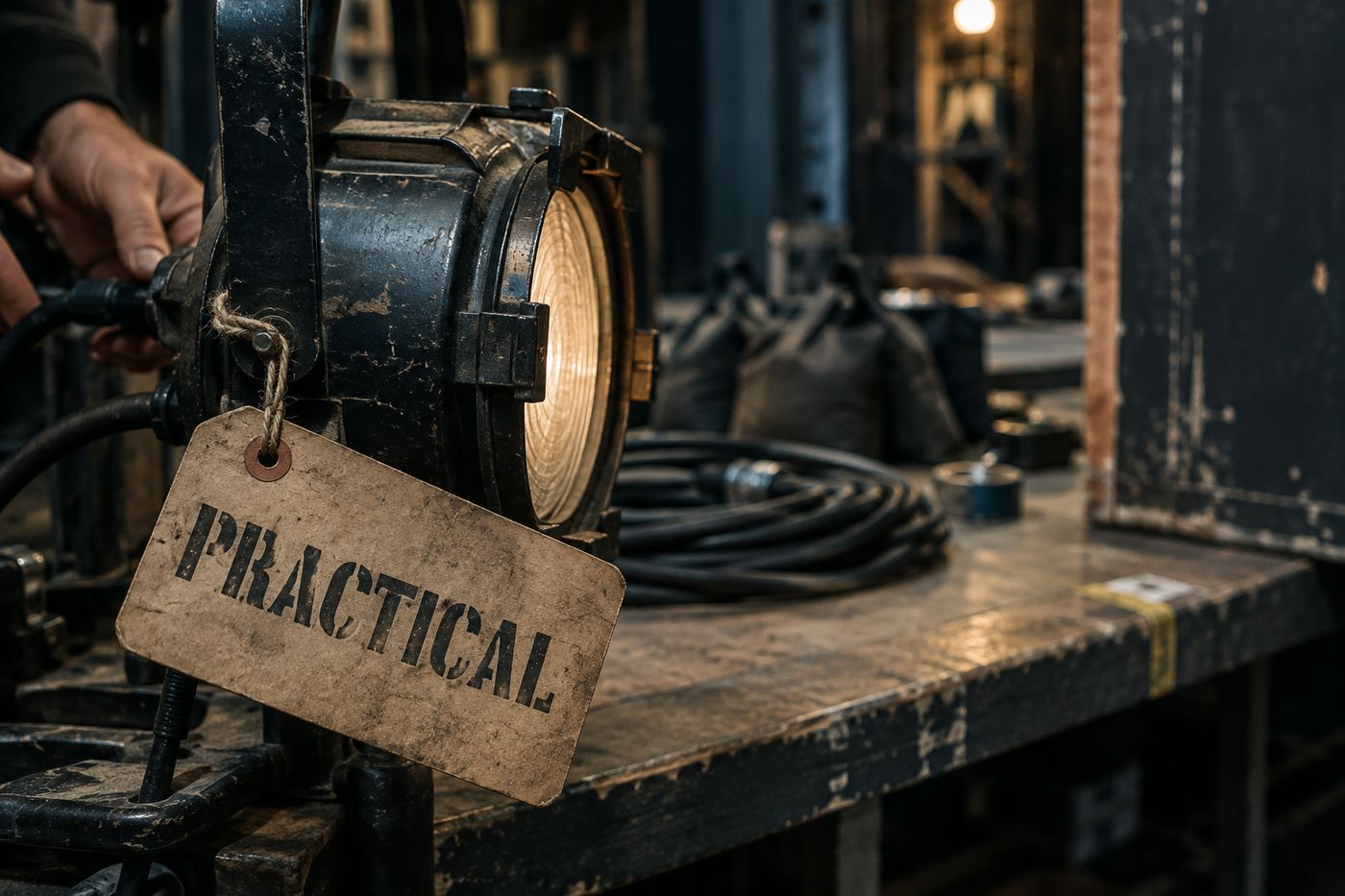
1 What It Means
A stage prop or piece of scenery built to actually function as its real counterpart would, such as a faucet that runs water or a lamp that truly lights.
2 Caught in the Wild
The lamp on the desk must be practical; the actor turns it on in blackout and the house needs to see it catch.
Illustrative usage · Undated
3 Where It Comes From
The word grows out of the older stage term 'practicable,' meaning a piece of scenery built to be used rather than merely painted flat, a door you can actually open instead of a door painted on canvas. Stage crews shortened and repurposed it until 'practical' became the working shorthand for any object required to perform its real function under lights. It never migrated into general English because the distinction it marks, real function versus visual illusion, only matters to the people building the set. Outside a scene shop nobody needs a single word for 'this prop actually has to work,' so the language had no reason to keep it once the curtain came down.
4 The World Behind the Word
Every prop on a stage falls into one of two categories, and the crew has to know which before the build even starts. A painted bookshelf can be flat foam core, because no actor touches it. But if the script has someone pour a drink from that bottle, the bottle has to hold liquid, pour correctly, and survive eight shows a week. That is a practical. Deciding what's practical shapes the whole production budget: real plumbing for a working sink means a water line run under the stage floor, real electrical wiring for a working lamp means an electrician signs off on it, and every practical adds rehearsal time because actors have to learn to operate something that behaves like the real object, not a prop standing in for one. Get the list wrong during design and you discover it during tech week, which is the worst possible time.
5 Use It Yourself
Reach for it anytime someone hands you something that looks finished but doesn't actually function, from a fake charging cable to a display model at a furniture store. Say 'is this practical?' among theater people and you'll sound like you know the shop. Say it anywhere else and you'll just sound oddly formal, so save it for the crew.
Try it out loud
We can't use the prop phone as a decoration, it needs to be practical since she answers it onstage.
🗝️The Deep Cut File
Practicals cause more onstage fires than any other category of prop, which is why fire marshals in most cities require a separate inspection for any open flame, however small, used as a working effect. A candle that must actually burn gets treated by code inspectors the same way a pyrotechnic charge would. That single distinction, practical versus decorative, is often the line item that determines whether a theater needs a standby fire watch crew member positioned in the wings for the entire run of the show, adding a paid position to the budget that exists purely because one prop had to be real instead of fake.