
1 What It Means
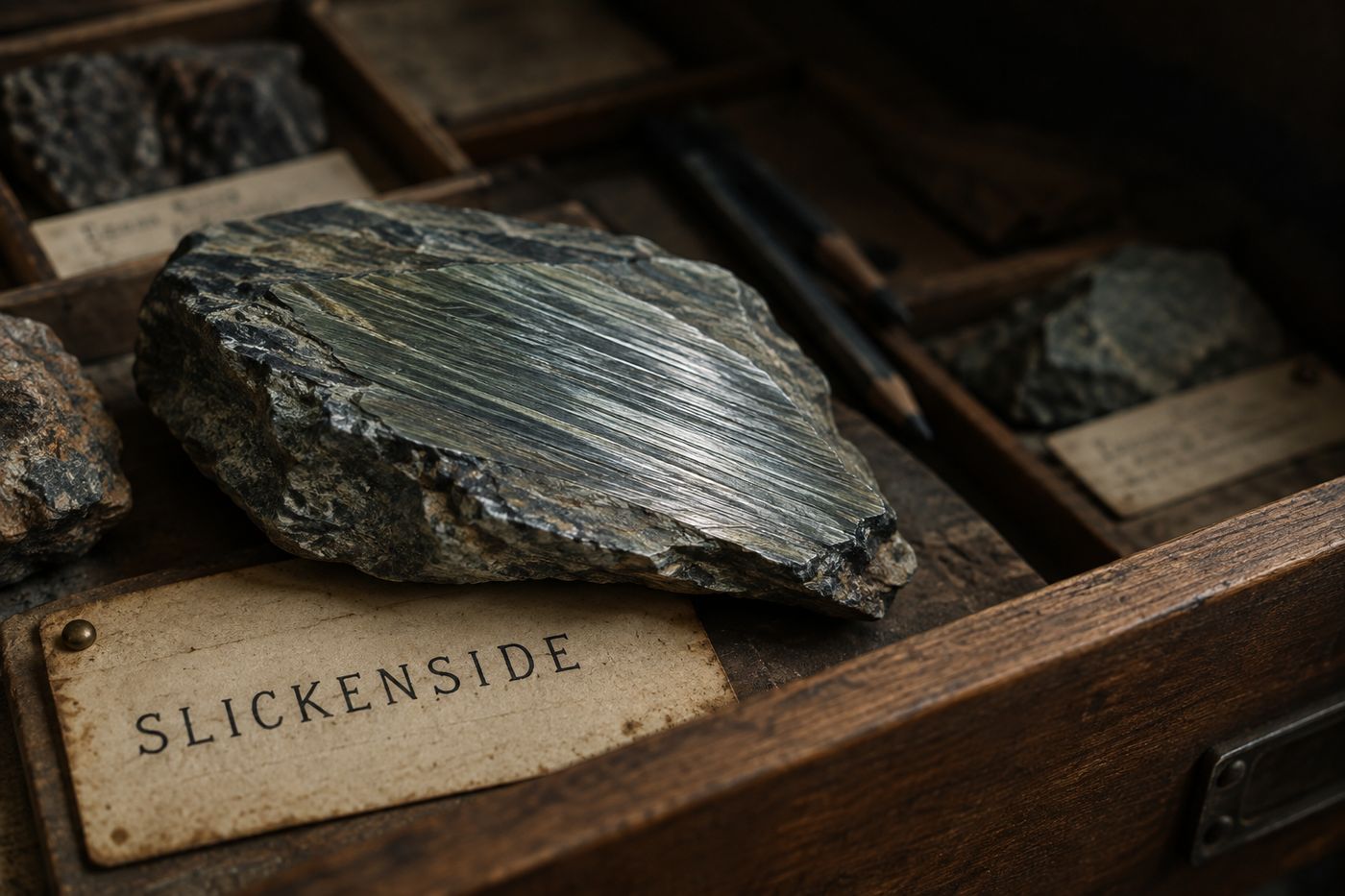
A smooth, polished, and scratched rock surface produced when two blocks of rock grind past each other along a fault plane.
2 Caught in the Wild
The outcrop showed a clean slickenside dipping steeply northeast, its grooves running parallel to the last movement direction.
Illustrative usage · Undated
3 Where It Comes From
The word fuses "slick," meaning smooth, with "side," the face of the rock in question. British and American miners and quarrymen used it informally long before geologists standardized it in the mid-1800s, when structural geology emerged as its own discipline. It never spread beyond the trade because the object itself is invisible to anyone who isn't cutting into rock or mapping a fault scarp. A general reader has no daily reason to name a scratched rock face. Geologists kept the word precisely because no other term captures both the polish and the direction of scoring in one noun, and that specificity is the whole reason it survives while so much period mining slang faded.
4 The World Behind the Word
Faults are fractures in the earth's crust where one block of rock has moved relative to another, sometimes by inches, sometimes by miles over geologic time. That motion generates enormous friction, and friction under pressure polishes the rock surfaces smooth while also scratching fine parallel grooves into them, called striations. A slickenside is the resulting surface, and it works like a signature: the direction of the grooves tells a geologist which way the blocks slid, and small steps or ridges in the polish, called slickenlines, can even show which direction was "up" during movement. Field geologists mapping earthquake hazards or mineral deposits rely on slickensides to reconstruct fault history without needing to see the fault actually move, since most faults last moved thousands or millions of years ago.
5 Use It Yourself
You won't drop this into small talk, but it is the perfect word for describing anything worn glassy-smooth by repeated friction, a stair tread, a rope groove, a well-used door hinge. Among hikers who've taken a geology course, pointing out a slickenside on an exposed rock face is a legitimate flex. Just don't expect anyone outside a field trip to know what you mean.
Try it out loud
He ran his thumb along the slickenside and said the fault had last moved sideways, not up.
🗝️The Deep Cut File
Slickensides matter far beyond academic mapping. Engineers checking dam sites and tunnel routes look for them because a slickenside means the rock has already failed once along that plane and is far weaker there than intact stone nearby. Miss one, and you might be building on a surface that's proven, in the geologic record, that it likes to slip. Some of the clearest examples in the world are exposed along the San Andreas Fault in California, where decades of erosion have peeled back the surface rock to reveal grooved, mirror-bright faces that look almost machined, though nothing but two continents grinding past each other made them.