1 What It Means
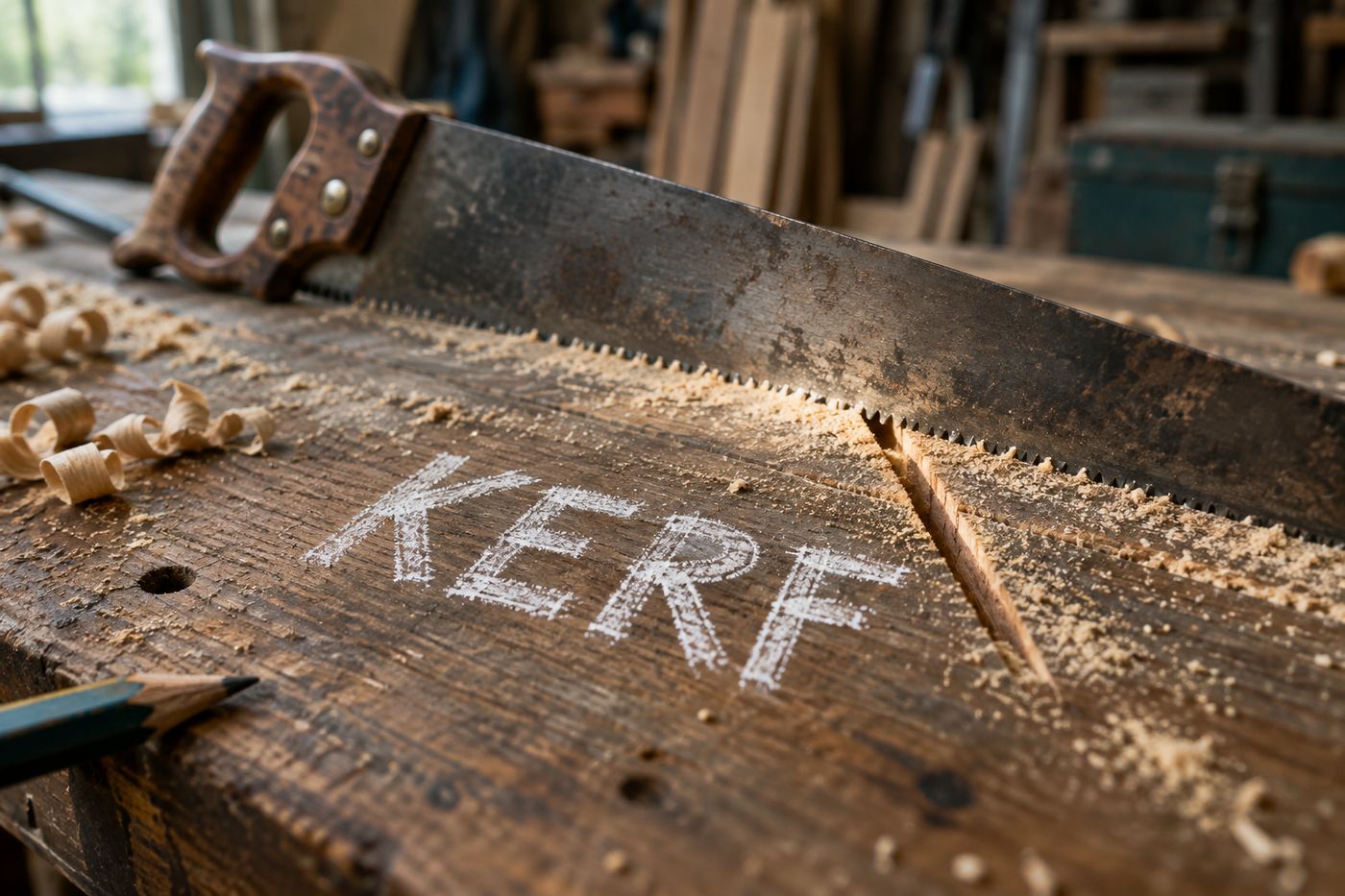
The narrow slit or channel a saw blade removes as it cuts through wood or another material, always slightly wider than the blade itself.
2 Caught in the Wild
Always mark your cut on the waste side of the line, or the kerf will eat into the piece you're keeping.
Illustrative usage · Undated
3 Where It Comes From
Kerf traces back to the Old English cyrf, meaning a cutting or a piece cut off, itself rooted in the verb ceorfan, to carve or cut. The word never wandered far from the workbench because it names something only someone holding a saw ever needs to think about. A general reader talks about cutting wood; nobody outside the trade needs a name for the material the cut actually removes. Sawmills and joiners kept the word alive precisely because the gap it names has real consequences: ignore it and your measurements are off by a blade's width, over and over, until a whole run of lumber comes up short.
4 The World Behind the Word
Every saw blade has thickness, and every pass through wood removes a strip exactly that wide, plus a hair more from the blade's set, the slight outward bend of alternating teeth that keeps the blade from binding in the cut. That removed strip is the kerf, and it is never zero. A cabinetmaker cutting four boards to the same length has to decide, before the first stroke, whether each cut takes its kerf from the keeper piece or the waste piece, because four kerfs' worth of sawdust adds up to a visible gap over a long enough run. Sawmills plan entire logs around it: a thick-kerfed blade turns more of the tree into sawdust and less into lumber, which is why thin-kerf blades became a selling point once timber got expensive enough that a few extra board feet per log mattered.
5 Use It Yourself
Reach for kerf anytime measurements come up short by a hair and nobody can explain why: a shelf that's a shade too tight, a picture frame with a gap at one corner. It reads as competent rather than showy, so it works fine dropped into a contractor conversation or a woodworking group chat, but it will get you a blank look at a dinner party unless someone there owns a table saw.
Try it out loud
I forgot to account for the kerf, so all four shelves came out a sixteenth of an inch short.
🗝️The Deep Cut File
Kerf shows up outside carpentry in a place most people never notice: welding and laser cutting borrowed the word directly, since a plasma torch or laser also removes a thin strip of material as it travels, and machinists have to program that width into their cutting paths the same way a sawyer accounts for it by eye. The word also survives in an old English surname pragmatically, Kerver or Carver, both descended from the same root verb for cutting, which means anyone named Carver is walking around with a linguistic cousin of kerf attached to their family for life.