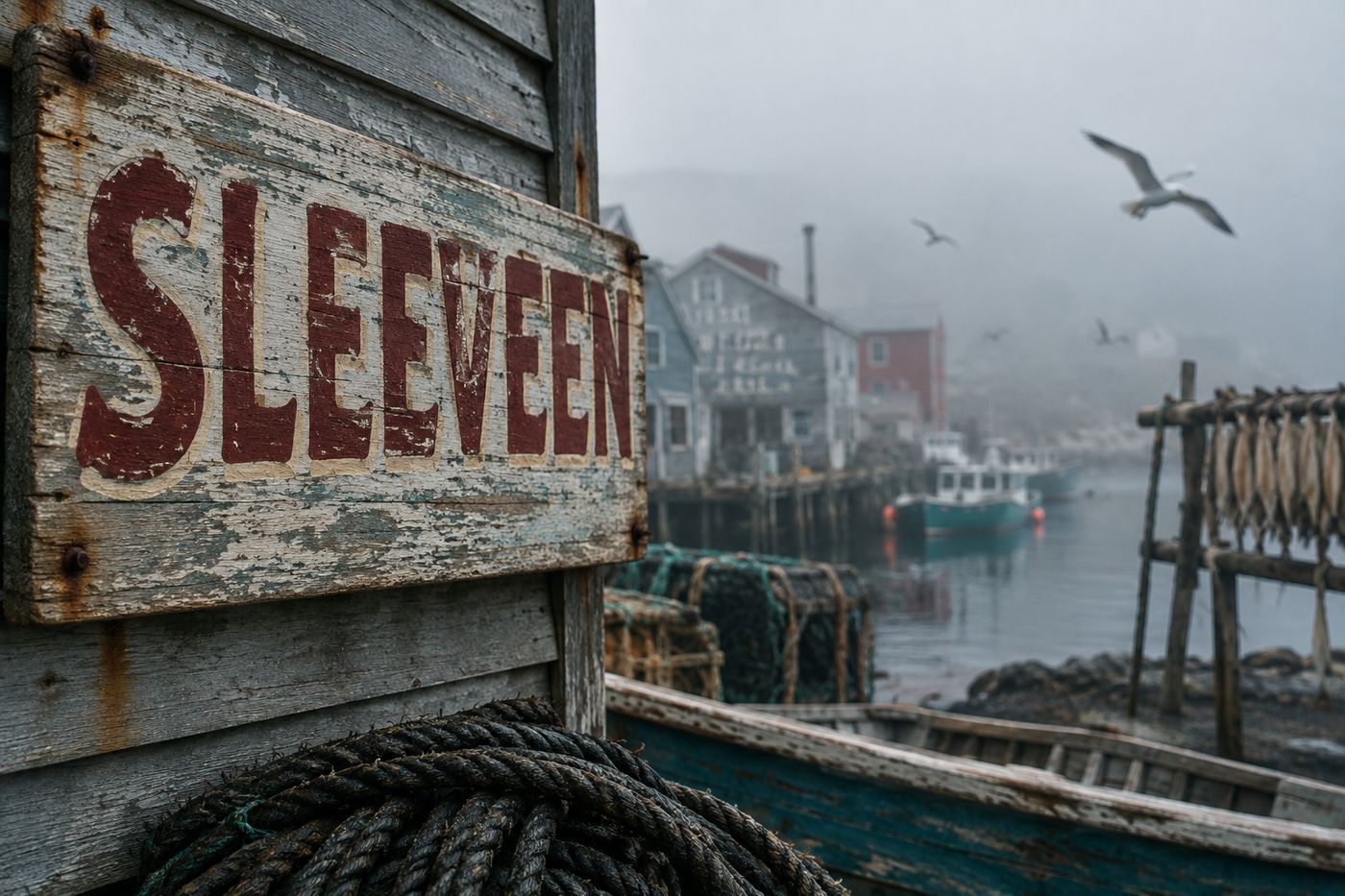
1 What It Means
A cunning, untrustworthy person who uses charm and flattery to manipulate others for personal advantage.
2 Caught in the Wild
"Don't trust that fella, he's a proper sleeveen, always got an angle."
Illustrative usage · Undated
3 Where It Comes From
Sleeveen traveled to Newfoundland with Irish settlers, coming from the Irish word slíbhín, meaning a mean, sly, or shifty person. It took root hard in outport speech, where a small community needed a precise word for the particular danger of someone who charms rather than threatens. It never crossed into mainland Canadian or American English because the word arrived with a specific immigrant population and stayed contained within that geography. Standard English already had con man and swindler doing similar work, so sleeveen never had to compete for a slot in the wider language. It simply kept living where the people who brought it kept living, which is why it still sounds foreign to almost everyone outside the island.
4 The World Behind the Word
Newfoundland English formed in relative isolation, shaped by Irish and West Country English settlers who fished the same coastline for generations with limited contact with the rest of North America. Small, tight communities depend on precise social vocabulary because reputation moves fast and everyone needs to know exactly what kind of person they are dealing with. A sleeveen is not a thief and not a bully. He is worse in a subtler way: someone who gets what he wants through flattery, a well-timed compliment, or a story that sounds just true enough. In a place where deals were sealed with a handshake and a season's catch depended on trusting your neighbor, having one word that flagged this exact character type, before he burned you, mattered more than it would in a city full of strangers and paperwork.
5 Use It Yourself
Reach for it the moment someone in a negotiation gets suspiciously friendly right before asking for something big, a landlord who compliments your apartment before raising the rent, or a coworker who flatters you into taking on their project. It carries none of the harshness of con man, so you can use it half-affectionately, which makes it oddly perfect for describing a charming but shady uncle.
Try it out loud
The contractor smiled the whole time he was overcharging us, an absolute sleeveen.
🗝️The Deep Cut File
The word made an unlikely leap into Canadian federal politics in the 1970s and 80s, when Newfoundland journalists and politicians used sleeveen in parliamentary debate and press coverage to describe opponents accused of underhanded dealing, occasionally forcing Hansard transcribers to record a word with no standard English equivalent. It even surfaced in a 1993 political scandal nickname. The word's brief mainland visibility never stuck, but it remains one of the few pieces of outport vocabulary that made it, however briefly, onto the national stage before retreating back to the island where it started.