1 What It Means
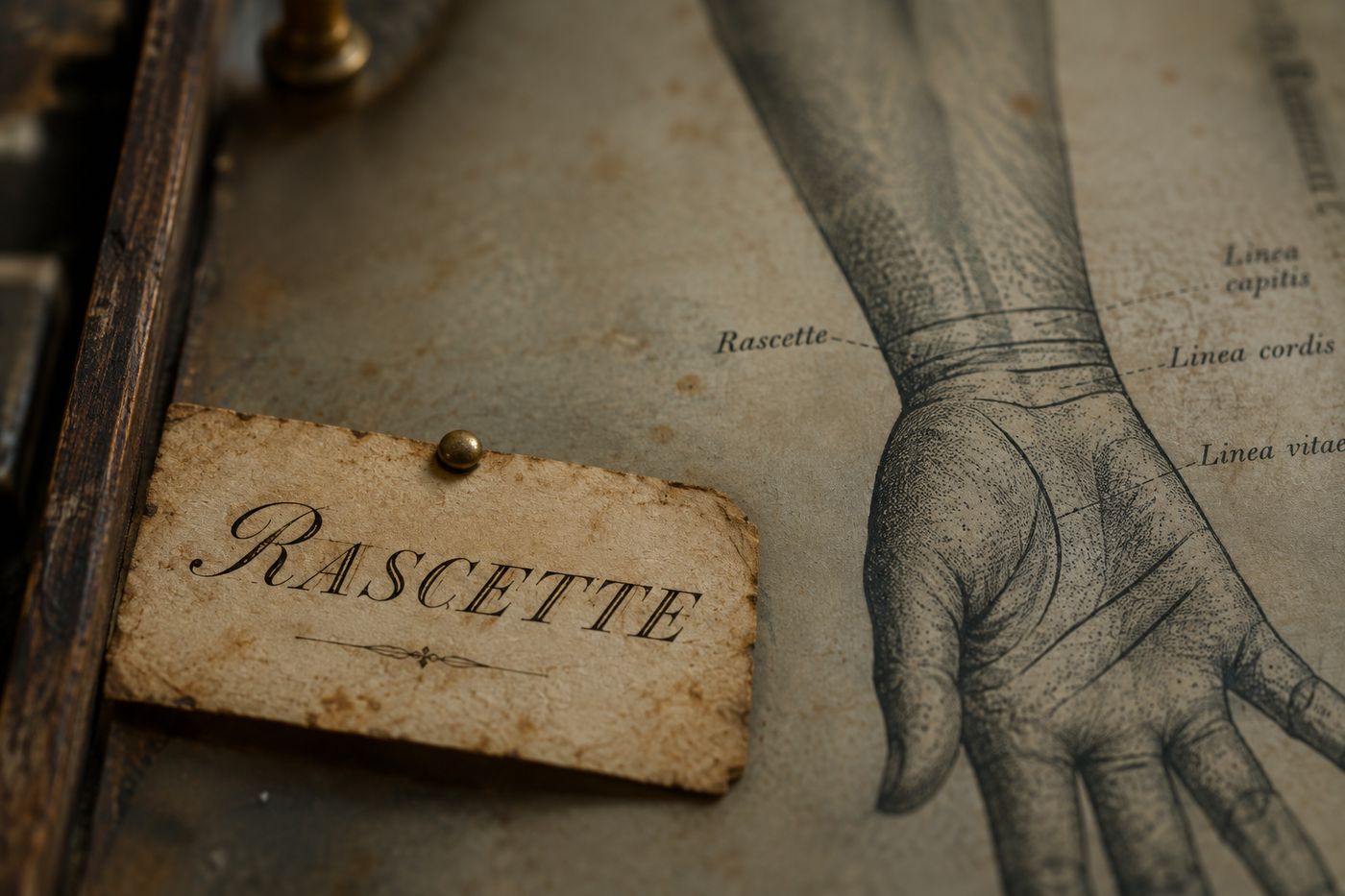
The word for one of the creases that forms across the inside of your wrist where your hand bends back toward your forearm.
2 Caught in the Wild
Rascette: the crease of the wrist, in palmistry supposed to indicate the length of a person's life.
Century Dictionary and Cyclopedia · 1889
3 Where It Comes From
Rascette comes from the French rassette, tied to the idea of a strap or fastening at the wrist, the same root family that gives English words for bracelets and wristbands. It entered English dictionaries in the 1800s mainly through palmistry manuals translated or adapted from French sources, where the wrist creases were counted and interpreted as signs of a person's remaining years. Once palmistry drifted from parlor entertainment to pseudoscience punchline, the word had nowhere respectable to live. Medicine kept the anatomy but renamed the creases with duller, more clinical language, and rascette was left behind with the tarot decks and the crystal balls, real but unwanted.
4 The World Behind the Word
Palmistry treated the hand as a readable document, and the wrist creases, the rascettes, were one of its central texts. Practitioners counted how many full, unbroken creases crossed the wrist, on the theory that each clean line signified a decade or more of life still ahead. A broken or faint rascette supposedly warned of trouble. None of this held up under any scientific scrutiny, but the observational habit was real: wrist creases do vary meaningfully from person to person, deep in some hands, barely visible in others, shaped by how the joint flexes and how the skin folds over a lifetime of use. Modern hand surgeons and physical therapists still note these creases when assessing wrist mobility, just without the fortune-telling attached.
5 Use It Yourself
Pull this out when someone at a farmers market palmistry booth starts tracing lines on your hand, or when a jeweler is fitting a bracelet and keeps pressing on your wrist joint. It sounds clinical enough to catch people off guard, and nobody will assume you are mocking them, which makes it safer than most obscure words for casual use.
Try it out loud
My palm reader traced my rascette and cheerfully told me I'd live past ninety.
🗝️The Deep Cut File
Palmists were not just counting rascettes for fun. Some 19th century manuals assigned a specific number of years to each visible crease, so a client with three clean lines walked away with a rough life expectancy handed to them like a receipt. The practice occasionally caused real anxiety, enough that a few doctors of the period wrote irritated letters dismissing it as dangerous nonsense preying on the nervous. The wrist creases themselves are entirely real and used today in hand surgery to plan incisions, since cutting across one can affect how the wrist moves afterward. The fortune-telling died. The anatomy stayed useful.