1 What It Means
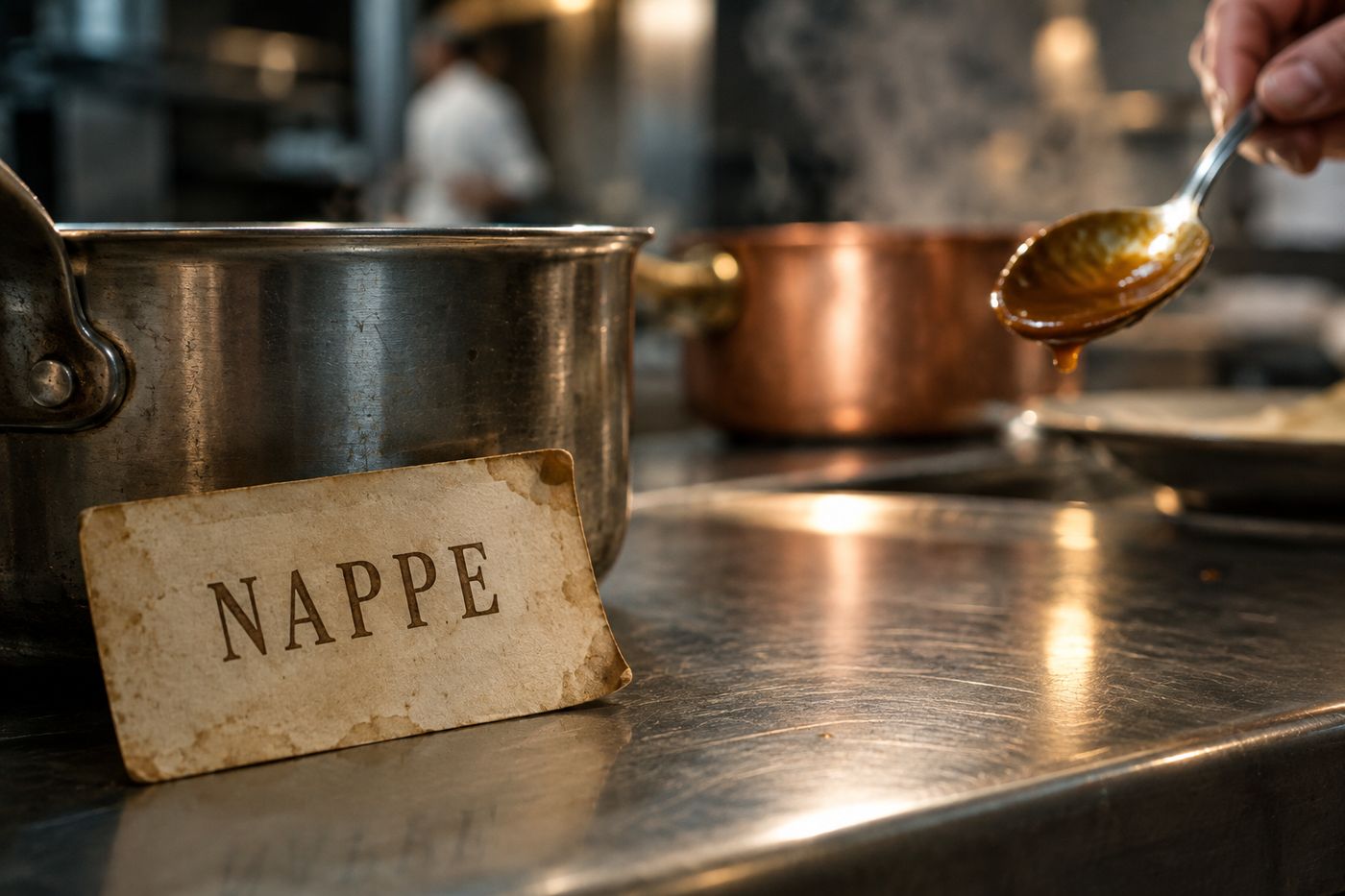
The point when a sauce has thickened enough to coat the back of a spoon evenly and hold a clean line when you run a finger through it.
2 Caught in the Wild
Cook the custard over low heat, stirring constantly, until it reaches the nappe stage and coats the back of a spoon.
Illustrative usage · Undated
3 Where It Comes From
Nappe comes from the French verb napper, to coat or cover, itself from nappe, a tablecloth, the image being a sauce laid smoothly over food like linen over a table. French kitchens exported it wholesale to professional English-language cookery in the early twentieth century, arriving with brigade-style training and Escoffier's codification of sauce work. It never spread past the line because home recipes solved the same problem with blunter instructions, phrases like thick enough to stick to a spoon, that need no French at all. The word stayed exactly where the precision mattered most and nowhere else, doing one narrow job for one narrow audience of people who test sauces for a living.
4 The World Behind the Word
Sauce work in a professional kitchen runs on texture, not taste alone, because a sauce that is too thin pools on the plate and a sauce too thick sits like paste. Cooks judge doneness by dragging a finger down the back of a coated spoon: if the trail stays clean and the sauce does not immediately run back together, it has hit nappe. This matters because recipes rarely give a reliable time or temperature for reduction, since stove heat, pan size, and starting liquid volume all vary. The spoon test replaces guesswork with a repeatable physical check anyone on the line can perform without a thermometer. It is one of a handful of tactile benchmarks, alongside things like ribbon stage for batters, that let a kitchen train new cooks to recognize doneness by feel rather than by the clock.
5 Use It Yourself
Reach for it when you are cooking a custard, gravy, or reduction at home and want to sound like you know exactly what you are doing, since most people will assume it is a fancy compliment rather than a technical checkpoint. It also works as shorthand in a group chat for anything that has finally thickened up, sauce or otherwise, once you explain the joke.
Try it out loud
Give the gravy five more minutes, it needs to hit nappe before we can plate.
🗝️The Deep Cut File
The same root gives English the word napkin, borrowed from Old French nappe through a diminutive form meaning small tablecloth, so a napkin and a properly reduced sauce share a linguistic ancestor. Escoffier's Le Guide Culinaire, the foundational French reference that shaped modern restaurant training worldwide, uses nappe consistency as a baseline standard against which other sauce textures, thinner or thicker, are measured and named. That single reference point is part of why the term survived unchanged for over a century inside professional kitchens while nearly everything else about cooking vocabulary drifted toward plain English.