1 What It Means
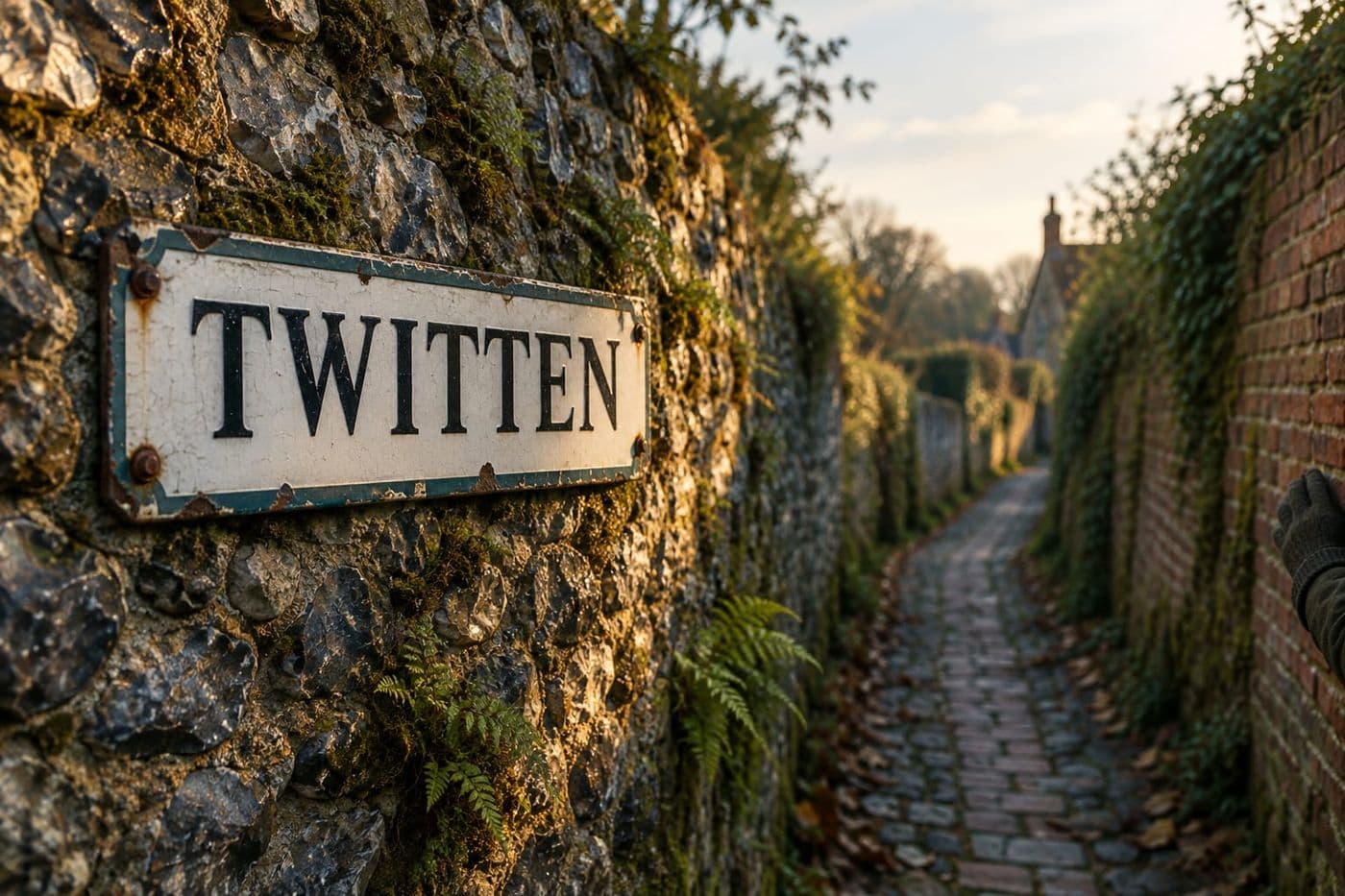
A narrow footpath running between two walls, fences, or hedges, especially in the towns and villages of Sussex, too tight for any vehicle.
2 Caught in the Wild
We cut down the twitten behind the church to dodge the traffic, and came out right beside the pub.
Illustrative usage. · Undated.
3 Where It Comes From
The trail goes cold early. Dictionaries record twitten as a Sussex dialect word and mark its origin as uncertain. Some word historians have wondered whether it belongs with old English words built on the idea of "between," which would suit a path that exists only because two boundaries stand close together. That remains a guess, and it should be read as one. What is clearer is why the word stayed home. A twitten is a feature of a particular landscape: chalk and flint country, old villages, lanes laid out long before cars. Other regions had their own terms for the same thing, such as ginnel, snicket, and jitty. Each word held its patch, and no national word ever replaced them.
4 The World Behind the Word
A twitten is the kind of path that exists because of what was built on either side of it. In old Sussex towns, houses, gardens, and flint-walled yards were packed along streets that predate the motor vehicle by centuries. Where two property lines met and someone still needed to get through, a thin passage survived. Locals use them as shortcuts, often without thinking about it. Walk the old lanes of Lewes or the North Laine district of Brighton and you will find them cutting between buildings, sometimes with a bend, sometimes with a few steps. A twitten is not quite a street and not quite an alley. It is a right of way for feet. That detail matters in a place where surveys, deeds, and local councils care a great deal about who may pass where. A general word such as "alley" suggests back-of-the-building grime. Twitten carries no such sense. It names a proper, public, habitual route.
5 Use It Yourself
Use it the next time you give directions in any town with old bones. "Take the twitten past the bakery" is clearer than "the little path thing," and it makes you sound like you have lived somewhere for decades. It also works in the group chat when you are describing a shortcut to dinner. The register trap is simple. Outside Sussex, hardly anyone will know it, so expect a blank look and be ready to gesture. Inside Sussex, using it as a tourist can sound a touch performed.
Try it out loud
Skip the high street and cut down the twitten by the chemist, it saves you five minutes.
🗝️The Deep Cut File
England has a surprisingly crowded shelf of regional words for this one idea. In Yorkshire and the north you hear ginnel and snicket. In parts of the Midlands you hear jitty or entry. In the south-east it can be a twitten. These are not synonyms in the sense of being interchangeable, because each belongs to the people who grew up using it. A Sussex local and a Leeds local can describe the same passage with different words and each find the other's choice slightly odd. Street signs in some Sussex towns use the word openly, which is rare for dialect. Most regional vocabulary lives only in speech, so seeing it in official lettering means the word has been treated as part of the place.