
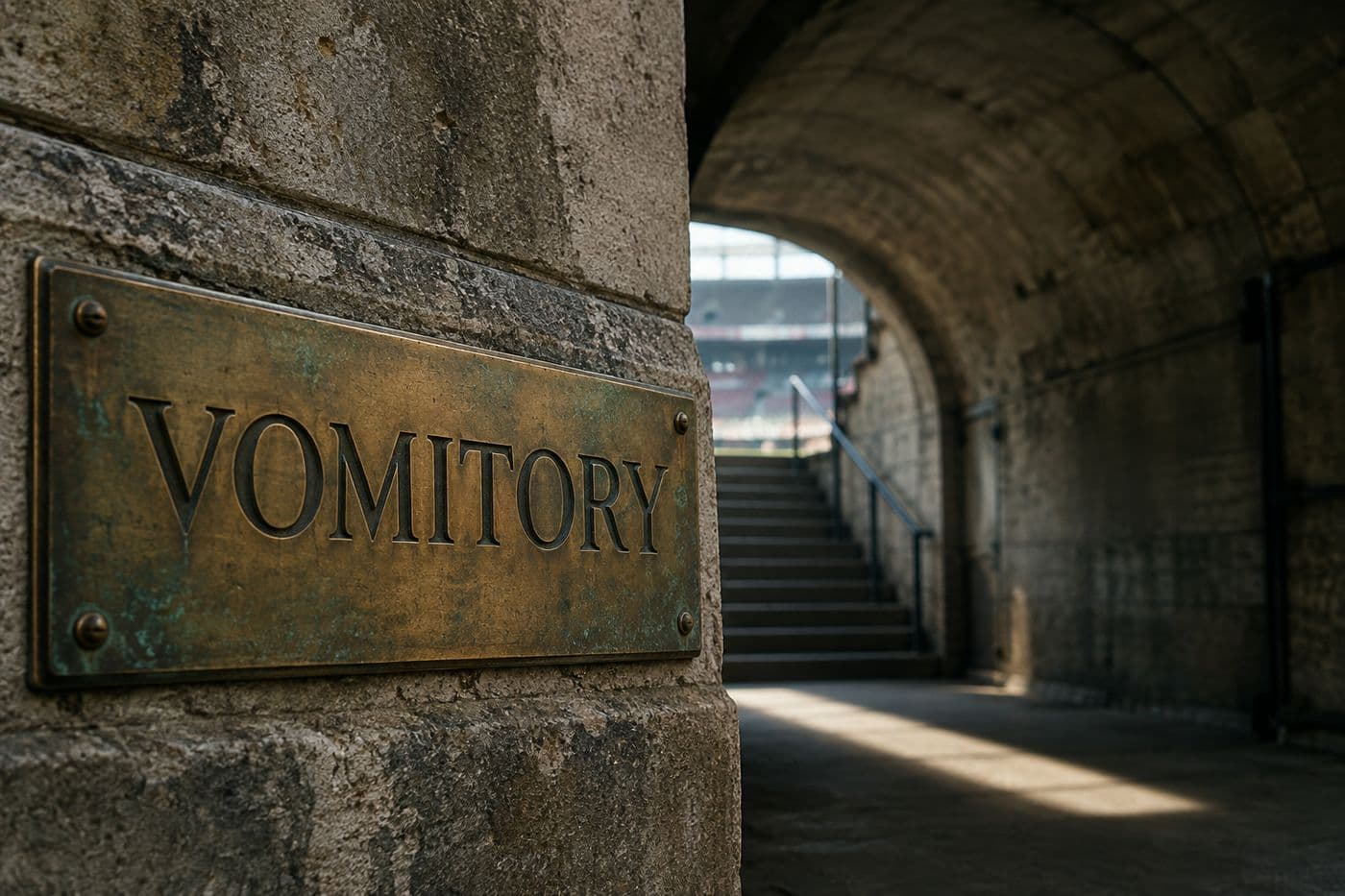
1 What It Means
A passage built into a theater or stadium that allows large numbers of people to enter or exit the seating quickly and at once.
2 Caught in the Wild
The vomitories, so essential to the rapid clearing of a crowded house, are placed at regular intervals beneath the seating tiers.
Illustrative usage · Undated
3 Where It Comes From
The word comes straight from Latin vomitorium, itself from vomere, to spew forth, describing how a Roman amphitheater passage disgorged its crowd onto the seating tiers. English writers borrowed the term wholesale by the 1600s to describe the same feature in theaters and later stadiums. It never migrated into everyday speech because the object it names only exists inside large public venues, and because the word's unfortunate resemblance to vomit makes casual writers reach for plainer alternatives like exit or aisle. Architects and theater historians kept it precisely because no other word names the specific engineering function this precisely.
4 The World Behind the Word
Theater and stadium architects face a brutal problem: thousands of people need to reach their seats and later leave within minutes, without crushing each other in narrow corridors. The vomitory solves this by cutting radial passages straight through the seating bank itself, rather than routing everyone around the perimeter. Roman engineers figured this out for the Colosseum, where dozens of these tunnels let fifty thousand spectators clear the building in a matter of minutes. Modern stadium designers still calculate vomitory width and spacing against crowd flow rates, treating it as a load-bearing safety question, not a cosmetic one. The term survives in architectural drawings and building codes because a passage cut through structural seating is a genuinely different design problem than a doorway, and the profession never found a better word for it.
5 Use It Yourself
Drop this at a concert or ballgame when someone asks which tunnel leads to your section, and watch the reaction. It sounds like an insult or a medical emergency, but it is neither. Architects and ushers use it without a flicker of embarrassment, so it works best around people who will recognize the reference rather than assume you are being crude.
Try it out loud
We got separated at the game because half our group used the wrong vomitory to get back to the seats.
🗝️The Deep Cut File
The Colosseum had around 80 vomitories ringing its seating bowl, a system so efficient that modern stadium engineers still study Roman crowd-flow numbers when designing new arenas. The word's Latin root, vomere, also gave English the ordinary word vomit, which is exactly why theater staff tend to just say tunnel or aisle around the general public. Architecture schools keep the technical term alive precisely because vomitory describes a load-bearing structural passage, a distinction that exit or doorway simply cannot carry in a construction drawing.