1 What It Means
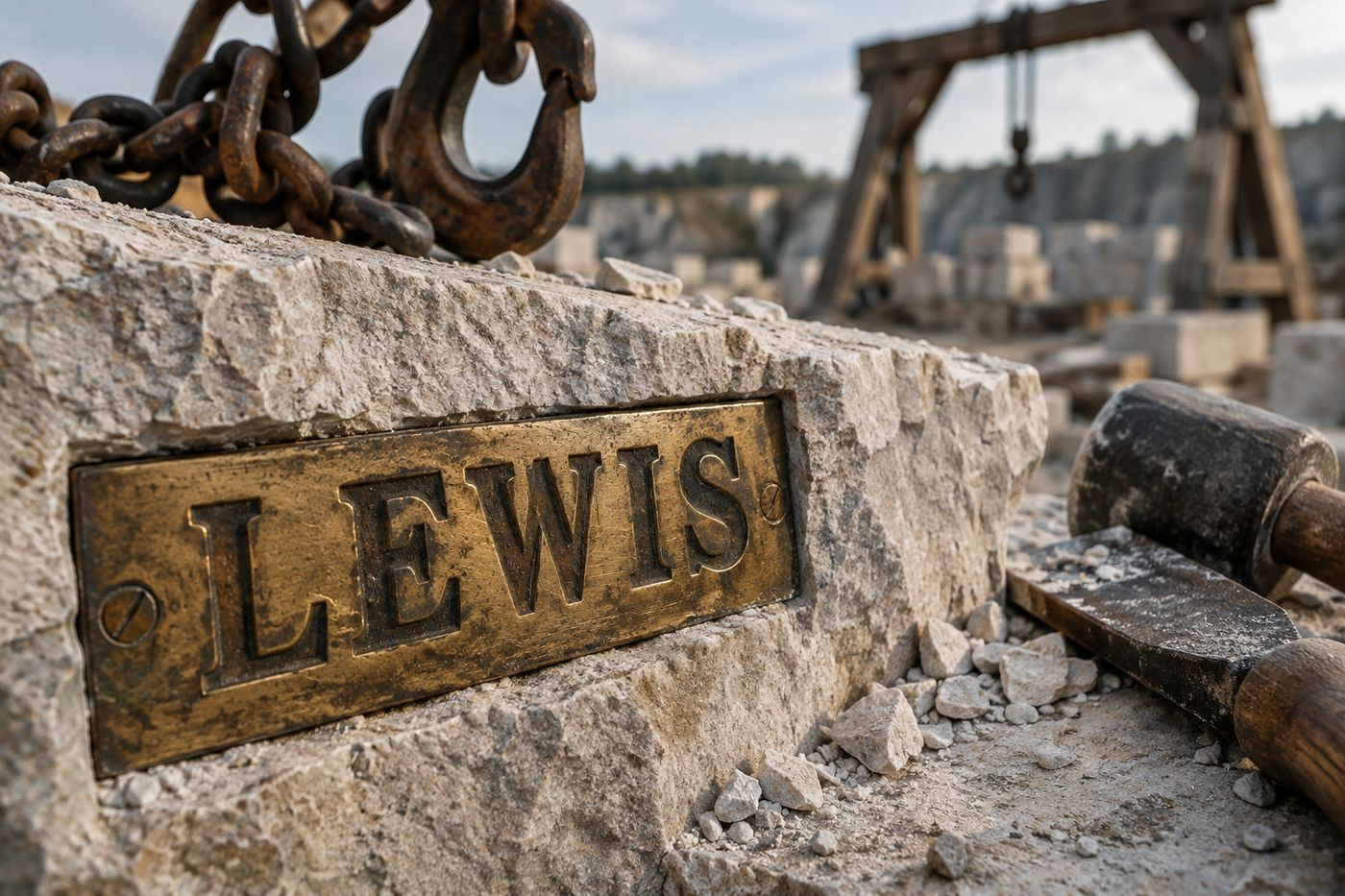
A metal device fitted into a dovetailed socket cut into a stone block, used with a crane to lift and set the stone without ropes or slings.
2 Caught in the Wild
The stone was prepared with a lewis-hole, into which the iron lewis was fitted, and by this means raised and set in its bed.
Peter Nicholson, The New and Improved Practical Builder · 1823
3 Where It Comes From
The name's origin is murky. Some trace it to a French engineer or inventor surnamed Lewis, though no single documented figure is confirmed, and the dictionary record leaves the attribution open. What is certain is the mechanism predates the name, appearing in stoneworking long before the English word settled on it. The term never spread past the trade because the object itself stayed inside the trade. Ordinary builders dealt in bricks and timber, materials light enough to lift by hand or simple pulley. Only mason's yards, quarries, and cathedral works needed a precise word for a device built specifically to lift dressed stone blocks weighing tons, so the word stayed locked inside that narrow, specialized world.
4 The World Behind the Word
Lifting a finished block of dressed stone presents a real problem. You cannot wrap a rope around it without risking chipped edges or a dangerous slip, and the whole point of dressing the stone is a clean, finished surface you do not want scarred by rope marks. The lewis solves this by working from the inside. The mason cuts a dovetailed socket into the top of the block, usually in three parts: two outer wedge-shaped pieces and a center pin. Fitted together, the pieces lock against the undercut sides of the socket so that any upward pull wedges them tighter rather than pulling them loose. A crane hook attaches to a ring above the assembly and lifts straight up. The heavier the stone, the harder the lewis bites. It is a piece of engineering logic solved centuries before anyone wrote down the physics.
5 Use It Yourself
You will not drop this into casual conversation, but it is a sharp word to know if you ever tour a cathedral restoration or watch a quarry crew set a cornerstone. It also makes a decent metaphor: the thing that holds tighter precisely when the pressure increases. Use it to describe a plan, a person, or a friendship that gets more solid under strain, and you will sound like you know something about engineering, not just vocabulary.
Try it out loud
The contractor used an actual lewis to set the granite lintel, the old way, no straps involved.
🗝️The Deep Cut File
The lewis has a quiet afterlife in the word 'lewis hole,' still used by monument restorers to describe the telltale dovetail socket carved into old stone blocks, sometimes centuries after the original lifting device has rusted away or been removed entirely. Architectural historians use these empty sockets to date construction phases and even to work out how a particular quarry or building crew operated, since lewis-hole shapes varied by region and period. So a tool meant purely for lifting ended up leaving behind an accidental signature, a kind of fingerprint stonemasons left in the rock without ever intending it as a record.