1 What It Means
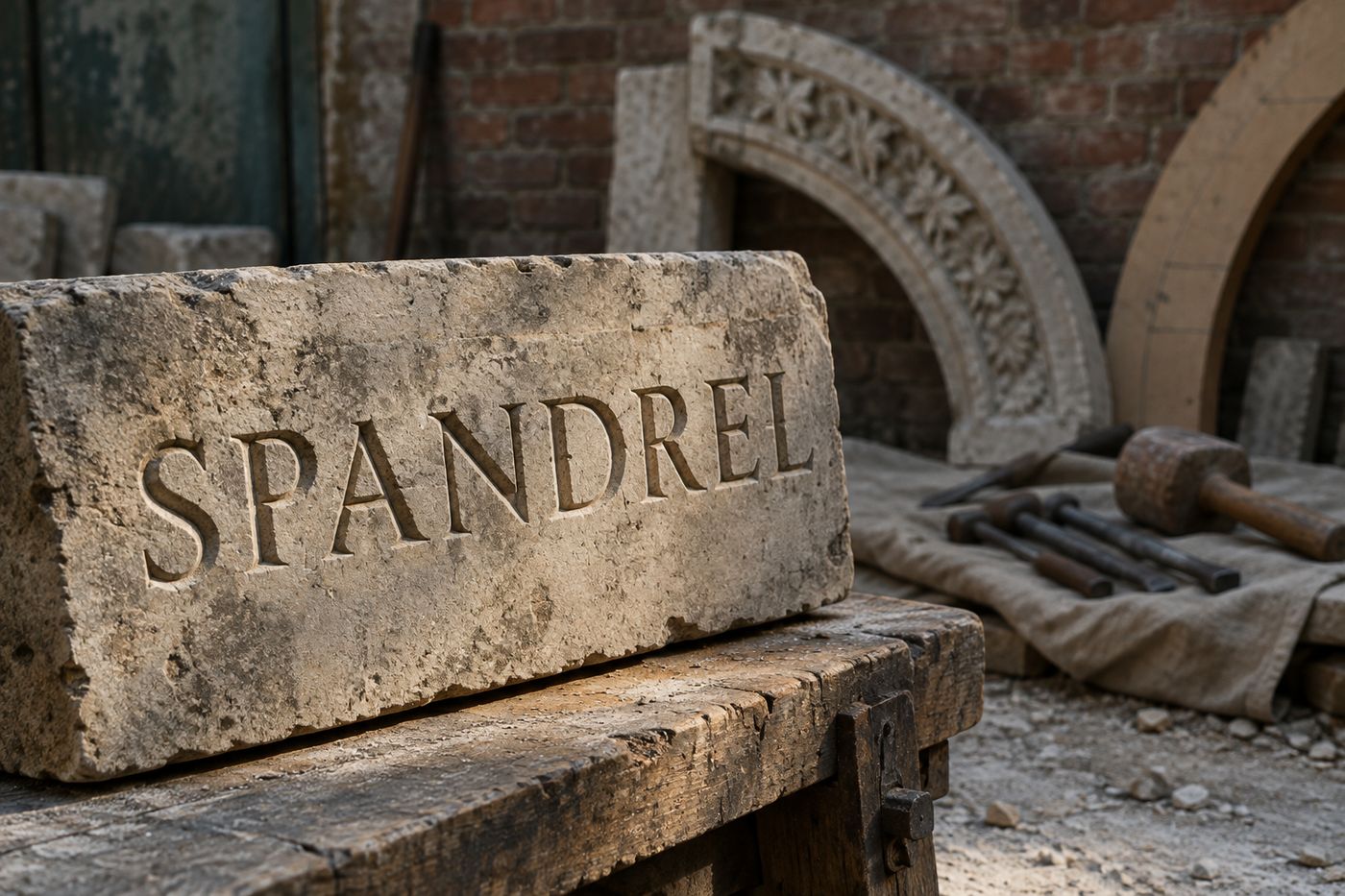
The almost triangular space between the curve of an arch and the rectangular frame enclosing it, often filled with decorative stonework.
2 Caught in the Wild
The spandrels above the nave arcade carry carved foliate bosses, original to the 1420s fabric of the church.
Historic England listing description, illustrative compilation of standard usage · Undated
3 Where It Comes From
Spandrel traces to Old French espandre, to spread or expand, filtered through Middle English as spaundrell by the early 1400s, when English masons were absorbing a wave of French building vocabulary alongside Gothic techniques. The word named a problem every arch builder faced: once you round a doorway or window, you are left with an awkward triangular gap between the curve and the straight frame around it. Masons needed to talk about filling, carving, or bracing that space, so the term stuck inside the guild. It never migrated outward because the shape itself rarely comes up in ordinary conversation. Nobody outside a construction site needs to discuss the leftover geometry beside an arch, so the word stayed where the arches were.
4 The World Behind the Word
Walk under any grand arched doorway, a cathedral porch, a Renaissance bridge, a bank lobby built to look important, and the spandrels are doing quiet work above your head. An arch is structurally a curve, but buildings are made of straight walls and square openings, so the stonework around an arch has to resolve a curve into a rectangle. That leftover triangular zone takes the compressive forces pushing outward from the arch's haunches and redirects them into the surrounding wall. Masons filled spandrels with coats of arms, foliage, grotesques, or plain ashlar, but structurally they were never optional decoration. Evolutionary biologists even borrowed the word in the 1970s to describe biological features that are structural byproducts rather than adaptations, which is the rare case of a stonemason's term escaping into an entirely different field.
5 Use It Yourself
Reach for this one touring old buildings, arguing with a contractor about a renovation estimate, or impressing a date at a cathedral by naming the carved triangle above the door. It carries zero insult risk, unlike words that sound technical but land as criticism. Just don't expect anyone outside architecture or biology circles to nod along without an explanation.
Try it out loud
The restoration budget blew up once they found rot hiding behind the carved spandrel over the west door.
🗝️The Deep Cut File
In 1979 biologists Stephen Jay Gould and Richard Lewontin borrowed spandrel for one of evolutionary biology's most argued essays, using the architectural leftover space as a metaphor for traits that arise as structural byproducts rather than direct adaptations. The paper, 'The Spandrels of San Marco and the Panglossian Paradigm,' pointed specifically to the mosaic-filled spandrels of Venice's Basilica di San Marco, arguing their elaborate decoration came after the structural necessity, not before it. The metaphor stuck so well in biology that many scientists now know the word only from evolutionary theory, with no idea it started in a mason's yard four centuries earlier.